
EN
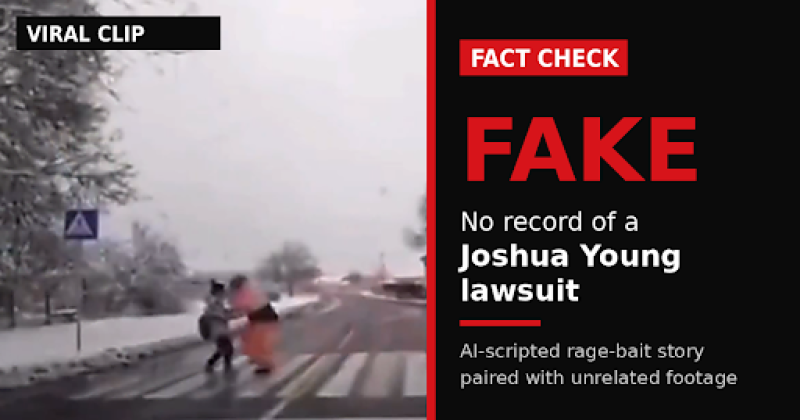
Short answer: No. The story of Joshua Young saving Charlotte Wilson from an oncoming car, then being sued for touching her without consent, is fake. There is no credible legal or news record of the incident. It comes from an AI-generated script that has spread widely on Facebook, TikTok and Instagram.
The videos tell the same dramatic story. A man named Joshua Young sees a woman, Charlotte Wilson, about to be hit by a car. He grabs her and pulls her to safety. Instead of thanking him, she sues him for touching her without her consent, and the case supposedly goes to court.
It is a story built to make people angry, and it works. Captions on pages sharing the clip ask how anyone could sue someone for saving their life, and the comments fill with outrage. But once you look for the people, the place or the court case, the story falls apart.
The narrative traces back to a fictional, AI-generated script that has gone viral across social media. Versions have been shared on Facebook, Instagram and TikTok. Some sharers have even acknowledged the AI angle: one Facebook page framed it as a warning about how AI can turn a hero into a villain.
Fact-checks have found no credible legal or news record of the incident. There are no court filings, local news reports, police statements or lawyer comments tied to a Joshua Young or a Charlotte Wilson in a case like this. A response on Threads to users asking about the story likewise noted there is no credible record of it.
The videos rely on a standard, AI-narrated script designed to stir outrage and drive engagement. They are usually paired with unrelated or edited surveillance and dashcam footage to make viewers believe the legal drama is real.
The Joshua Young video follows a template that viral pages use again and again. Here is how to spot it.
These stories almost always use very common English names, such as Joshua Young, Charlotte Wilson or Sarah Jenkins. The names feel familiar, but they make it nearly impossible to search for the real people involved. Thousands of people share those names, so a quick search never leads to a clear answer.
The videos rarely say where the incident happened (no city or state) or when (no date). They never name the court, police department or lawyers. Without those details, viewers cannot check local court records or local news to see whether the case is real.
The narration usually comes from a recognisable, robotic or overly dramatic AI voice. On-screen text often flashes one word at a time in bright yellow or green. This lets content farms produce hundreds of videos a day with text-to-speech tools, without hiring voice actors.
The video stitches together dramatic clips, such as a dashcam near-miss, a courtroom hallway or stock footage of an angry woman, that do not match. Look closely and the cars, weather and clothing change from shot to shot. The clips are taken from elsewhere online to create a backdrop for a made-up script.
The plot is engineered to make you angry, following the same pattern: a hero does something clearly good, the person he helped reacts with extreme ingratitude, and the system punishes the hero. Anger is one of the most shareable emotions online. Furious viewers flood the comments, which pushes the video further in the algorithm and earns its creators more views and ad revenue.
Fake rage-bait stories may seem harmless, but they cause real damage. They spread false ideas about how courts and consent laws work, and they can discourage people from helping others in an emergency. They also stir up anger against whole groups of people based on events that never happened. Pages that build big audiences with fake stories can later use that reach to push scams, dubious products or misleading links.
If you see the Joshua Young video, do not comment or share it, since engagement helps it spread. Use the platform's report option for false information instead.
Joshua Young did not save Charlotte Wilson and then get sued for touching her. The story is an AI-generated fake with no legal or news record behind it, built from generic names, missing details, stitched-together footage and an outrage formula designed to go viral. When a story makes you instantly furious, that is the moment to stop and check it.
Adam Collins is a cybersecurity researcher at ScamAdviser who operates under a pseudonym for privacy and security. With over four years on the digital frontlines, he specialises in translating complex threats into actionable advice. His mission: exposing red flags so you can navigate the web with confidence.
