
EN
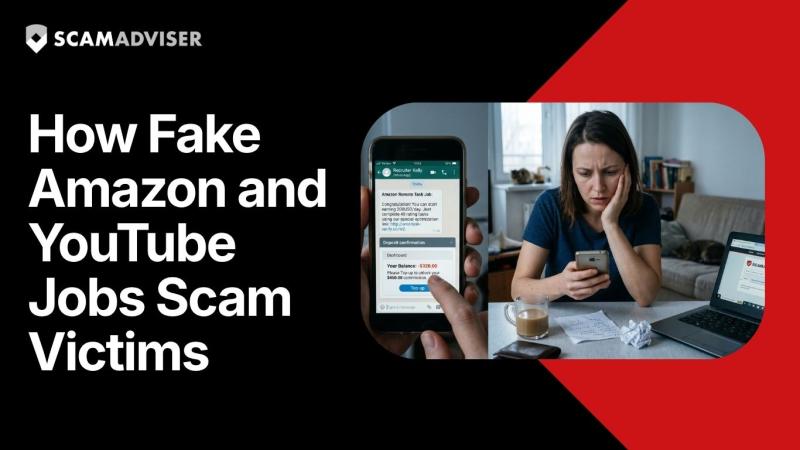
You won't believe the lengths scammers go to make fake Amazon and YouTube jobs look legitimate. Some victims are even paid real money before being lured into a scam that can cost them thousands.
In a Nutshell
A message arrives out of nowhere claiming Amazon or YouTube is hiring for flexible, high-paying remote work — zero experience required. Scammers weaponize these multi-billion-dollar brands because their actual hiring ecosystems are so massive that casual job seekers rarely question the need for decentralized global workers.
The pitch is carefully designed to sound like modern, plausible digital labor.
The scammers typically claim you'll be helping to:
! Reality Check: Amazon's official corporate hiring policy explicitly states they never conduct interviews, extend job offers, or request banking details via WhatsApp or text — YouTube recruits exclusively through Google Careers.
Massive tech companies do not manage payroll through generic websites registered last week. Legitimate hiring flows through applicant tracking systems like Workday or Greenhouse — not encrypted chat apps.
Legitimate recruiters rely on tracked, corporate communication channels. Scammers immediately migrate you from SMS to WhatsApp or Telegram. This is a tactical necessity, not incidental:
Messaging apps allow scammers to operate more freely, manage multiple victims at once, and avoid many of the spam detection systems used by mobile carriers.
The conversation often feels surprisingly professional. You may be assigned a "trainer" or "mentor" who guides you through your first tasks and answers questions.
This personal attention helps build trust and makes victims less likely to question what comes next.
! Rule of thumb: If a "recruiter" asks you to continue the conversation on WhatsApp, Telegram, or any app outside a company's official domain, terminate contact immediately.
You may find our platform-hopping scams article.
To dismantle your doubts, the platform gamifies onboarding. After clicking a few buttons, the platform allows you to withdraw a small, real financial payout — typically $15 to $50 — directly to your bank account or crypto wallet.
Scammer Sends $20 Bait → You Lower Your Guard → You Deposit $500 → Account Frozen ✕
This is a calculated loss leader. By sending you real money, the scammer transitions your mental state from skeptical observer to active employee. The sunk cost fallacy — our tendency to persist in endeavors we have already invested in — does the rest of the work.
Tasks are structured in sets, frequently rounds of 40. Midway through, the fake platform triggers a pre-programmed "Lucky Order" or "Double Task" event. Your dashboard balance suddenly swings deeply negative:
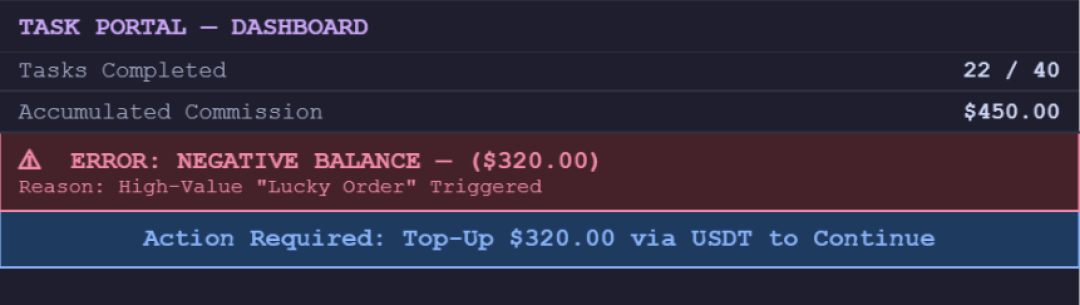
The handler explains a high-value product optimization occurred and you must "top up" with USDT (Tether) to clear the deficit and unlock your earnings.
! What actually happens: If you pay, the algorithm hits you with a larger negative balance on task 38. Demands scale from hundreds to thousands until you are financially exhausted. The platform then freezes your account and the handler blocks your number.
Why Cryptocurrency?
Scammers insist on crypto for one reason: irreversibility. Unlike bank transfers, a validated blockchain transaction cannot be reversed or recalled by any bank or third party. The money is gone the moment it leaves your wallet.
While the financial loss is immediate, the secondary phase is silent — and arguably more dangerous. During "onboarding," victims submit employment documentation: driver's licenses, passports, or Social Security Numbers.
During the fake hiring process, scammers frequently request:
! Synthetic Identity Fraud: Real information (your SSN) is blended with fabricated details (fake name, address, birth date) to construct a ghost credit profile. Because the real victim sees no lines of credit opened in their name, this can go completely undetected for months or years — quietly destroying credit infrastructure in the background.
According to the Federal Reserve, synthetic identity fraud is the fastest-growing financial crime in the US. The FTC estimates millions of Americans are affected each year.
There are several ways you can protect your digital footprint. Here is why;
Run any platform URL through ScamAdviser or an ICANN WHOIS lookup. A domain registered less than six months ago operating under a Fortune 500 brand name is an absolute certainty to be fraudulent.
! Zero exceptions: Legitimate employers pay you. They never require cryptocurrency, gift cards, or any financial transaction to unlock wages or complete an application.
✓ Freeze your identity immediately. Contact Equifax, Experian, and TransUnion to place a credit freeze or fraud alert.
✓ Cease all communication. Cut off contact. Do not attempt to negotiate or chase your funds.
✓ Report it officially. File with the FTC at ReportFraud.ftc.gov and the FBI via IC3.gov.
✓ Alert your DMV or passport agency that your credential image has been compromised.
! Beware secondary recovery scams. After losing money, you will be targeted by "recovery agents" claiming they can hack the platform to retrieve your crypto. These are secondary scams. There is no technical mechanism to reverse blockchain transactions.
Frequently Asked Questions
Can I recover cryptocurrency sent to a task platform?
No. The core architecture of cryptocurrency is immutable and decentralized. The CFTC and SEC both confirm there is no equivalent of fraud protection or chargebacks in crypto markets.
Why did the fake platform send me real money at the start?
It is a calculated psychological compliance tactic. The $20 payout buys your trust, ensuring you feel safe enough to later deposit $2,000 or more. The scammer treats this as a marketing cost with a high return on investment.
What happens if scammers have a photo of my ID?
They will package it with other stolen data to construct synthetic identities. Immediately place a credit freeze with all three bureaus, set up monitoring at AnnualCreditReport.com, and contact your local DMV or passport agency.
How do I verify whether a job offer is real?
Navigate directly to the official career portal. Amazon jobs are listed exclusively at amazon.jobs. YouTube roles appear at careers.google.com. Call the company's public HR line to verify any offer before sharing personal information.
Should I report this even if I didn't lose money?
Yes. Reporting non-financial encounters helps law enforcement map scam networks. File with the FTC, the FBI IC3, and forward suspicious messages to your carrier's spam line (7726 in the US).
Adam Collins is a cybersecurity researcher at ScamAdviser who operates under a pseudonym for privacy and security. With over four years on the digital frontlines, he specialises in translating complex threats into actionable advice. His mission: exposing red flags so you can navigate the web with confidence.
