
EN

Social media has recently been flooded with an emotional story claiming that Melania Trump and her son Barron Trump have quietly opened a free hospital for homeless people in the United States. The posts describe a modern medical center offering lifelong care at no cost, with housing and other services included. Emotional images often accompanying the heart touching story, making it highly shareable. But is this story genuine, or is it just another viral fake post designed to mislead users? Let’s find out.
The claim first appeared on a Facebook account named Gaviur Textil. This post quickly gained attention, prompting numerous other Facebook accounts to share the same content. Such rapid sharing is a common trait of viral misinformation. By the time the story started trending, many users assumed it was real simply because of how widely it had circulated.
The viral posts even provided a detailed description of the supposed hospital, often referred to as the “Melania–Barron Trump Legacy Medical Center,” claiming it offered 250 beds, lifelong medical care, and housing for homeless people. Some posts also claimed that the hospital opened quietly without public announcements, portraying the Trump family as personally involved in this charitable initiative.
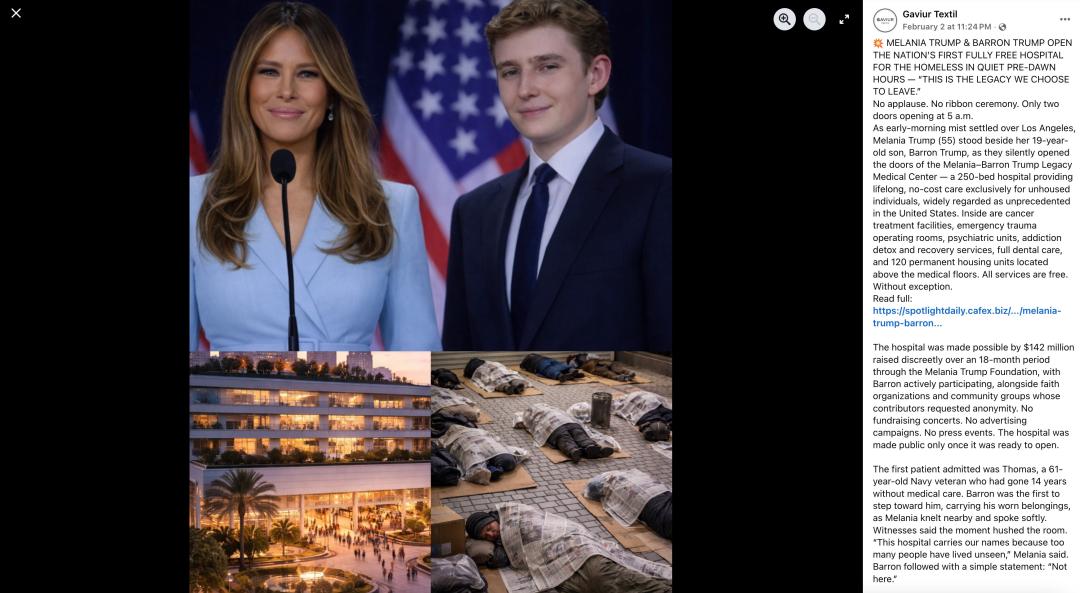
According to Snopes, this story is false. Snopes confirms that there is no credible evidence that Melania or Barron Trump opened any free hospital for homeless people. The images accompanying the posts are flagged as AI-generated, and the text is fabricated. No reputable media outlet or official statement supports the claim.
If such a large scale hospital existed, it would almost certainly have been covered by mainstream news outlets and recognized by medical or charitable organizations. The lack of verifiable sources is a major indicator that the story is misleading.
Several red flags make it clear that this story is not genuine:
These factors together make the story highly suspicious and confirm that it is intended to go viral rather than provide factual information.
The rapid sharing of this claim highlights how misinformation travels on social media. The story originated on a single account, then was picked up by many others, giving the illusion of credibility. Social media algorithms often amplify emotionally appealing content, regardless of its accuracy. Even positive sounding news can mislead people if they do not check trusted sources before sharing.
Based on all the above factors, the claim that Melania and Barron Trump opened a free hospital for homeless people is entirely fabricated. There is no genuine evidence supporting the story, and it should be treated as misinformation. Readers should rely on verified sources and fact checking platforms before accepting viral claims, even if they seem heartwarming.
This incident underlines the importance of verifying information online. Even positive sounding claims should be examined critically, especially when they involve famous personalities or large scale charitable initiatives. Using reliable sources and recognizing viral red flags can help prevent the circulation of misleading content.
