
EN
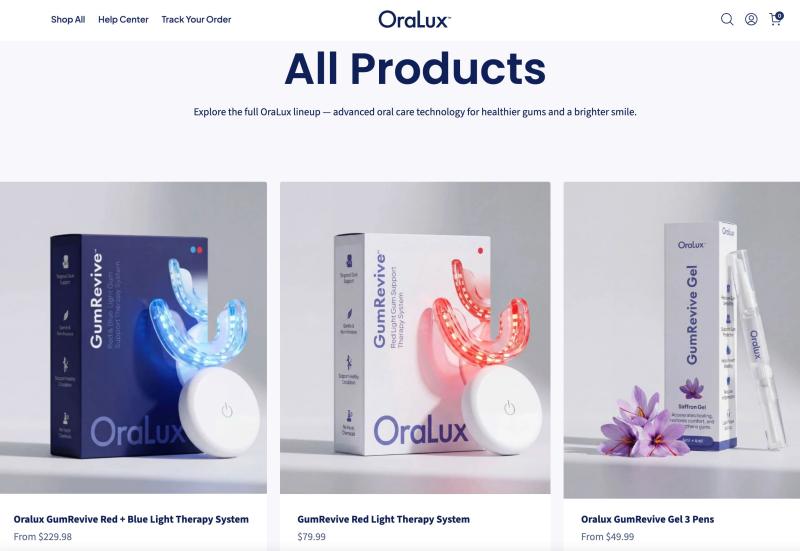
Promoted as an at-home photobiomodulation system, Oralux GumRevive claims to improve gum health within 90 days, raise the gum line, close gaps between teeth, and potentially reduce the need for costly dental procedures. Its lineup includes red-light, red-and-blue-light devices, and gel pens. While light therapy has legitimate research behind it for areas such as inflammation, pain, healing, and circulation, it cannot appear to replace professional dental treatment or rebuild lost bone and receded gum tissue.
Our review examines these claims, the website’s disclaimers and FDA classification, along with customer feedback covering convenience, reported benefits, delivery issues, technical problems, and expectations.
Based on the information as provided on current listings on the official storefront, the Oralux "GumRevive" system appears to be divided into three primary product offerings:
Oralux GumRevive Red Light Therapy System ($79.99): The standard mouthpiece utilizing 32 LEDs delivering 630nm Red Light and 850nm Near-Infrared wavelengths. It is designed to be used hands-free for 12 minutes a day to target circulation.
Oralux GumRevive Red + Blue Light Therapy System ($229.98): This version retains the 16 red light LEDs (620nm) but introduces 16 blue light LEDs (460nm). It extends the daily cycle slightly to a 10-to-15-minute auto-shutoff routine aimed at managing oral bacteria alongside tissue health.
Oralux GumRevive Gel Pens ($49.99 for a 3-pack): Formulated with Saffron extract, Xylitol, and Sodium Hyaluronate. It is marketed as a topical companion to protect the tissue and shield sensitive root surfaces between light therapy sessions.
The core marketing premise across these products is that receding gums are not caused by hygiene failures, but rather by sagging collagen scaffolds, much like aging skin on the face. Oralux positions this as a problem for dermatology rather than traditional dentistry.
To view this product objectively, it is helpful to weigh its mechanical intent against standard medical care. Professional clinical procedures, such as deep cleanings (scaling and root planing), are designed to physically remove hardened tartar and active bacterial infections hidden deep beneath the gum line. When advanced tissue loss or structural recession occurs, surgical interventions like gum grafts physically replace missing tissue to cover exposed roots.
In contrast, at-home light devices do not appear to provide structural repair or mechanical cleaning. They seem to be designed primarily as non-invasive wellness habits intended to stimulate blood flow and support localized cellular activity. Because an at-home light mouthpiece may not be capable of removing sub-gingival calculus or rebuilding lost bone support, it appears to function as a general, top level supplementary habit rather than a treatment for active or advanced dental disease.
When looking closely at the promotional layout of the storefront, there are several significant nuances that consumers should carefully evaluate before purchasing.
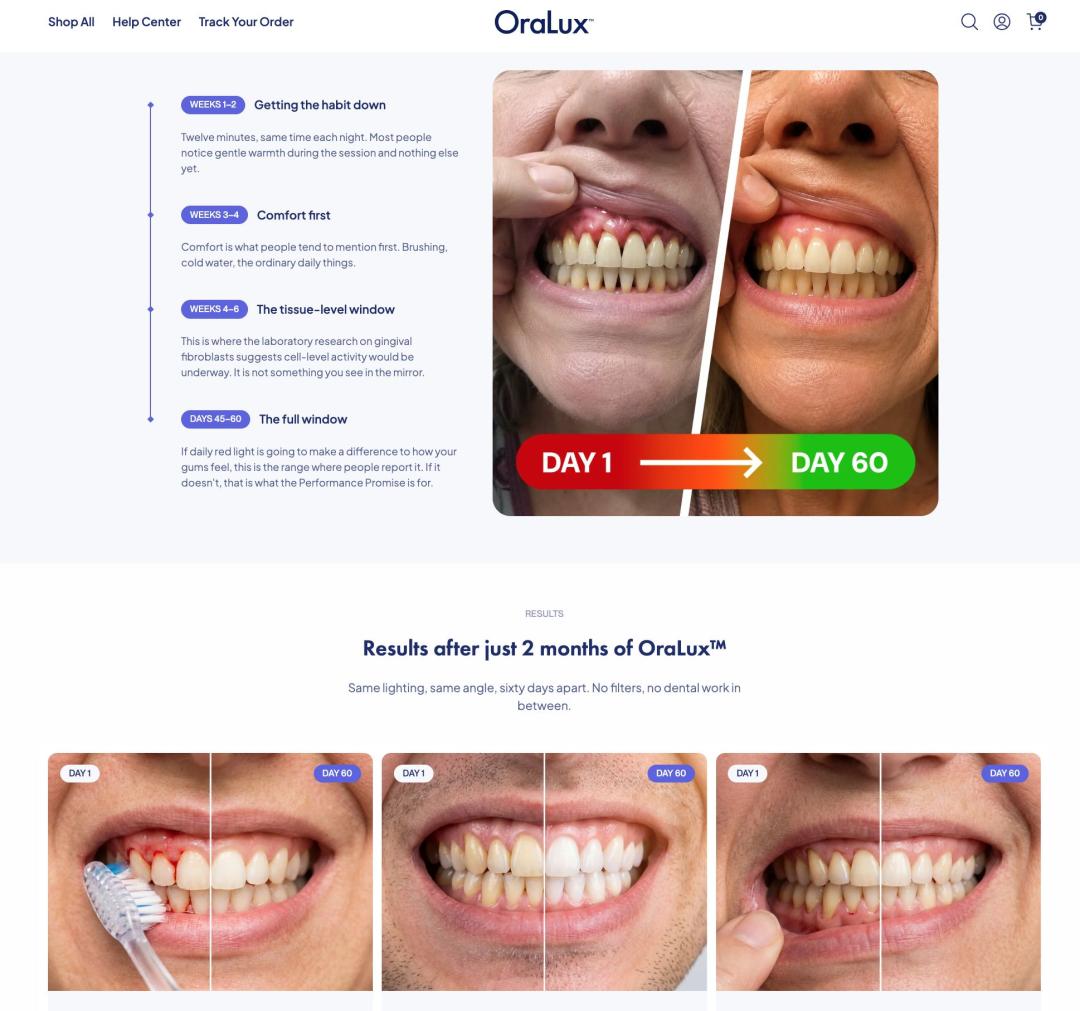
The storefront's marketing graphics showcase side by side photographic comparisons tracking a 60-day timeline. Visually, these images focus on changes in tissue appearance, displaying gums that appear visibly red and irritated on Day 1 changing to a pinker, calmer appearance by Day 60. The accompanying text notes that users may notice differences in how their gums feel during this window. However, a notable detail for consumers to keep in mind is the formal health disclaimer located in the storefront's footer.
The text explicitly states that the product is "not intended to diagnose, treat, cure or prevent any disease" and is "not a substitute for professional dental care". This presents a standard regulatory contrast: while the website's imagery highlights visual improvements in gum redness and irritation over a two-month period, the formal documentation clarifies that the device functions as an over the counter wellness aid rather than a clinical medical treatment for periodontal conditions.

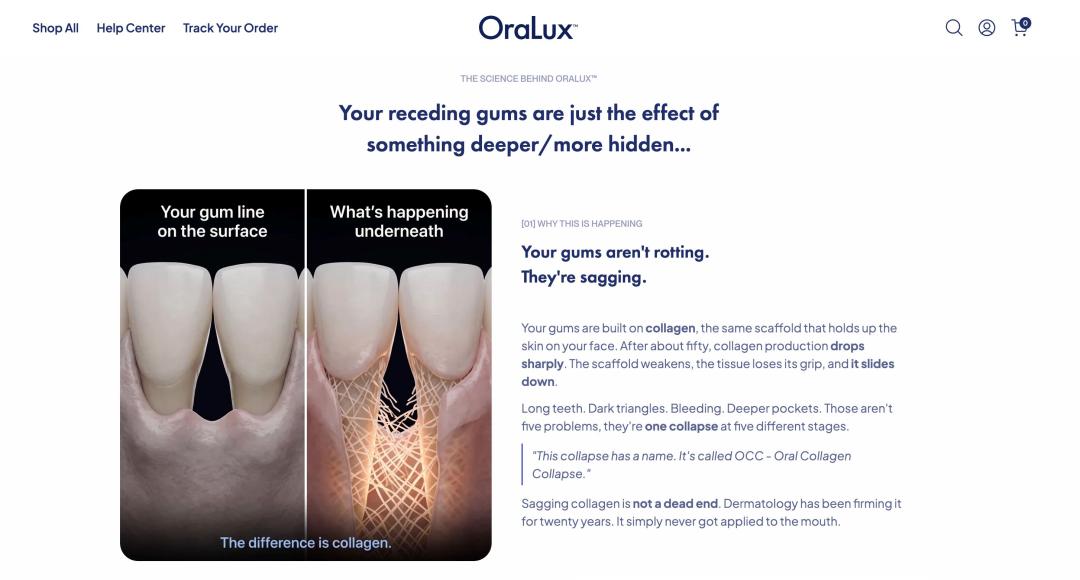
The storefront's promotional text attributes shifting gum lines to a structural process it terms "OCC - Oral Collagen Collapse," stating that "your gums aren't rotting. They're sagging." The marketing notes that "dermatology has been firming it for twenty years" and that this approach" simply never got applied to the mouth" until now.
From an educational standpoint, this concept presents a different perspective than standard dental diagnosis models. While structural collagen support naturally shifts with age, clinical dental science generally defines progressive gum recession as the result of active bacterial plaque, chronic inflammation, mechanical trauma (such as aggressive brushing), or underlying bone degradation.
Describing gum recession primarily as a cosmetic style collagen sagging issue differs from traditional periodontal science, which focuses heavily on managing bacterial infections to protect the underlying jawbone structure.
Photobiomodulation (red, near-infrared, and blue light therapy) is a legitimate area of scientific study. It has shown promise in clinical trials for reducing inflammation, easing pain, and accelerating wound healing after oral surgeries.
The addition of the 460nm Blue Light wavelength is based on recognized laboratory research showing that blue light can have antimicrobial effects against certain periodontal pathogens under specific laboratory environments. However, there may be a definitive limit to what light therapy can achieve at home:
No Proven Structural Regeneration:
Biological gum tissue does not appear to possess the capacity to spontaneously grow back or climb back up an exposed tooth root once the underlying alveolar bone has been lost. Once the bone structure retreats due to disease, the gum tissue generally follows it. At-home light devices do not seem capable of rebuilding lost jawbone.
Circulation Support vs. Disease Cure:
While red light can temporarily increase local blood circulation, increased blood flow alone may not eliminate deep sub-gingival calculus (hardened tartar) or cure advanced periodontitis.
The Caveat in the Code:
As shown on the Oralux page, the device is Class II, 510(k)-exempt under 21 CFR § 890.5500 (product code ILY). According to the official U.S. Food and Drug Administration (FDA) Product Classification Database, this code designates an "infrared lamp for therapeutic heating".
In standard regulatory terms defined under the US Electronic Code of Federal Regulations (eCFR), this specific category is intended for temporary relief of minor muscle or joint pain, relaxation of muscle spasms, or a temporary increase in local blood circulation, rather than a clinical clearance to treat, reverse, or cure structural periodontal disease.
An evaluation of user commentary shared on independent consumer platforms, such as Trustpilot, indicates a notable variance in individual experiences and perceptions regarding both the order fulfillment process and product utility:
Oralux GumRevive seems to be a real physical product shipped by an active company; in a strictly legal and transactional sense, the product does not seem to be a financial scam, as a physical device or product package is typically shipped to your home. It utilizes wavelengths of light that are recognized in localized wellness applications for circulation, minor inflammation control, and topical bacteria management. However, because a notable gap exists between the storefront's prominent visual depictions of gum line changes and the biological realities of tissue regeneration, overall consumer satisfaction heavily depends on maintaining realistic expectations.
If viewed strictly as a supportive wellness habit to supplement standard oral hygiene routines, the system may offer minor circulatory benefits. Conversely, utilizing the device with the expectation of reversing bone loss or bypassing a necessary clinical dental procedure will likely result in disappointment.
This article is an objective review intended strictly for educational, informational, and critical commentary purposes under fair use guidelines. The analysis, data points, and observations expressed herein are based on an independent evaluation of publicly available marketing materials, official storefront disclosures, regulatory listings, and third party consumer feedback platforms at the time of writing. Reading or interacting with this content does not establish a doctor-patient, dentist-patient, or client relationship.
We do not state or claim that this product is a scam, nor do we imply that every customer will have an identical experience. The delivery of a physical item confirms the operational legitimacy of the storefront, and individual user results may naturally vary depending on unique personal circumstances. This review does not promote, endorse, or condemn the product; rather, it encourages consumers to carefully evaluate marketing claims, ingredient profiles, digital storefront transparency, and independent empirical evidence before making an autonomous purchase decision.
This review does not constitute professional medical or dental advice, diagnosis, or treatment. At-home wellness products, personal cosmetic-style devices, and topical solutions should never be used as a substitute for professional clinical evaluation, deep cleanings, diagnostics, or surgical care provided by a licensed dentist, periodontist, or oral surgeon. Always consult a licensed healthcare professional, physician, or dental specialist before introducing any new device, dietary components, or wellness routines to your physical care.
All product names, logos, brand assets, and trademarks (including "Oralux" & "Oralux GumRevive") are the sole property of their respective owners and are utilized here exclusively for descriptive, educational, and contextual identification purposes under fair use and fair comment guidelines.
This article has been written by a Scam Fighter Contributor, De-Reviews.com Team. If you believe the article above contains inaccuracies or needs to include relevant information, please contact ScamAdviser.com using this form.
De-Reviews.com Team is a group of scam researchers, editors, and online safety advocates dedicated to exposing online fraud and helping consumers stay safe online. The team has been investigating scams, fraudulent websites, phishing campaigns, and other online threats since 2014. Read the Full Author Profile.
